Why Legacy JBoss ON / RHQ Tools Are Holding Back BFSI Platform Teams
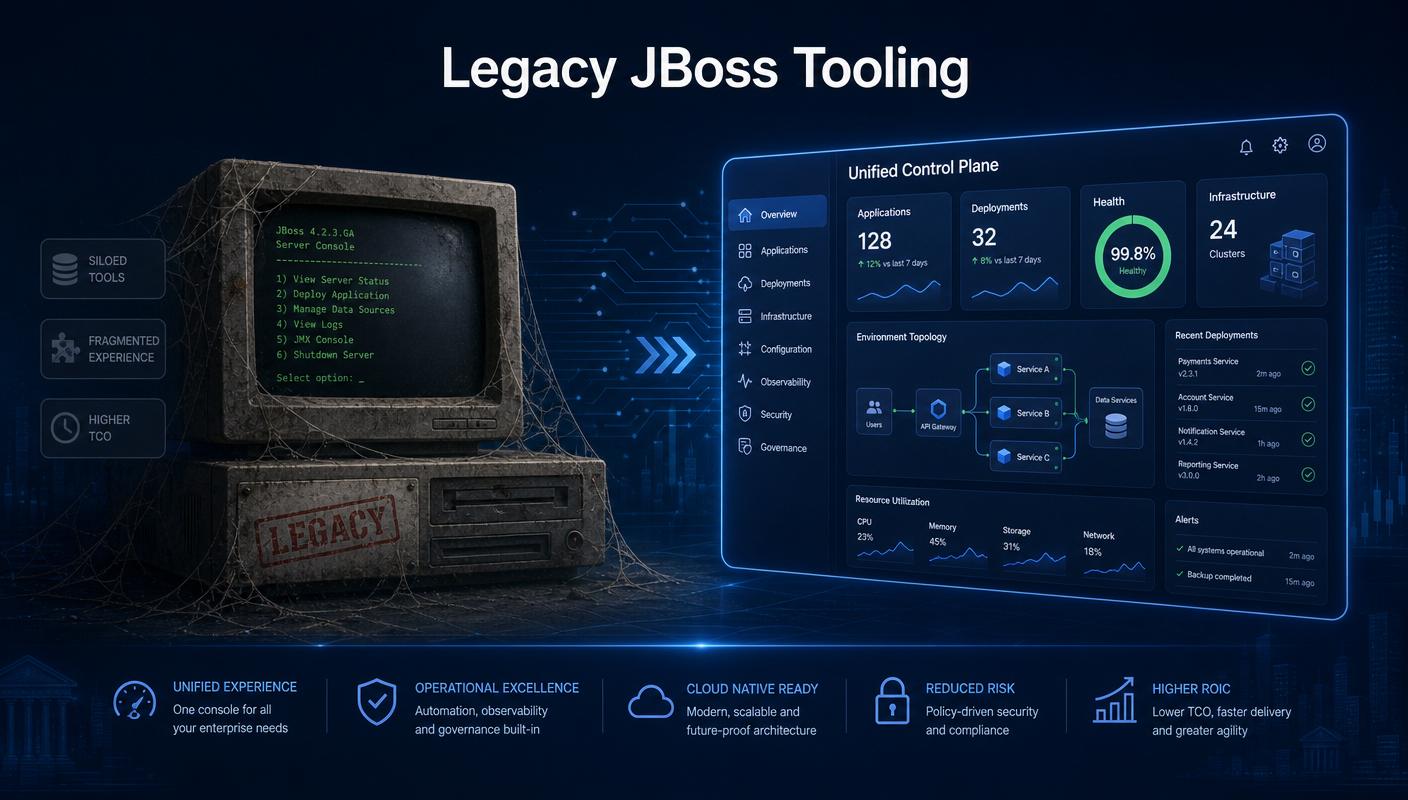
For more than a decade, JBoss Operations Network (JBoss ON) — and its open-source ancestor RHQ — has been the default monitoring and administration layer for enterprises running JBoss EAP at scale. In banks, insurers and NBFCs, it quietly underpinned the operational visibility of core platforms running on JBoss for years. But the gap between what JBoss ON was designed to do and what modern BFSI platform teams actually need has now widened to the point where most organisations treat it as legacy.
An operations console built for a different decade
JBoss ON's architecture reflects the early-2010s view of the world: a heavyweight agent-and-server topology, a relational inventory model, and a UI optimised for individual resource configuration rather than fleet-wide operations. That made sense when most banks ran a handful of JBoss domains in a single data centre. It does not match a 2026 reality where the same bank may operate hundreds of JBoss instances across production, UAT, dev, DR and air-gapped enclaves, often spread between on-prem hardware and private cloud.
Where legacy tooling actively slows BFSI teams down
- Fragmented visibility: separate consoles for monitoring, deployment, certificate tracking, MQ health and log analysis force engineers to context-switch during incidents.
- Slow root cause analysis: alerts arrive without correlation, leaving SREs to manually stitch together JVM metrics, GC behaviour, thread dumps and deployment history.
- Configuration drift: with no first-class drift detection, small changes in standalone.xml or domain.xml across environments quietly diverge until they cause production incidents.
- Compliance friction: BFSI auditors expect strong AD/MFA integration, immutable audit trails, and clear evidence of change control — areas where legacy tools require heavy customisation.
- Limited automation surface: scripting around JBoss ON typically means brittle CLI wrappers, not a proper API-first control plane.
The cost is measured in MTTR, not licences
Most BFSI platform leaders we speak with do not frame this as a licensing problem. The real cost shows up in mean time to resolution. When a transaction-processing slowdown hits a core banking platform during peak hours, every minute spent jumping between consoles, exporting logs and manually reading heap dumps is a minute of customer-visible degradation. Legacy tooling does not actively cause incidents, but it makes resolving them dramatically harder than it needs to be.
What a modern JBoss control plane looks like
The shift we see across the industry is toward a single, AI-aware control plane purpose-built for JBoss — one that unifies multi-environment dashboards, deployment, GC and heap analysis, log correlation, MQ and EJB monitoring, certificate tracking and access control behind one operator console. The goal is not to replicate JBoss ON feature-for-feature. It is to give platform teams the leverage they need to run JBoss the way modern SRE practice expects: declaratively, observably and with intelligent assistance during incidents.
Moving on without ripping things out
Migration off legacy JBoss ON does not have to be a forklift exercise. Most BFSI teams start by layering a modern control plane alongside their existing setup, onboarding non-production environments first, validating drift detection and AI-assisted RCA against historical incidents, and only then redirecting on-call playbooks. Done well, the transition takes weeks rather than quarters — and the operational gain is usually visible within the first incident cycle.